Monday, November 17, 2014

Guimaras Island: An eco-spiritual Travel to Trappist Monk Monastery

Guimaras Island: An Eco-Spiritual tour at Trappist Monk Monastery
When you heard Guimaras what comes into your mind? Of course if you have no idea about this place you probably think and ask twice. So let's start with a  very nice short history about this beautiful enchanting island.
Jordan Pier, Guimaras
Jordan Pier


A NICE HISTORY:
In 1521, after the defeat of Ferdinand Magellan, the Spanish survivors aboard three vessels went to Leyte to undergo some repairs.  Later they abandoned one of the vessels named Concepcion in Bohol for being unsea worthy and sailed towards the nearby islands of Negros and Panay.

R. Morales, an author of the book “The Augustinians in Panay” published in 1987, believed that the Spaniards must have cruised close to the southern coasts of Negros and Panay.  The utterly homesick Portuguese mariner could have given the name Guimaraez to that small island lying very near to Panay’s southeast shores, in order to immortalize in this part of the world the first capital of the country and the birthplace of Portuguese nationality: Guimaraez.

Guimaras was cited in numerous documents and books on natives who are “masters in building all kinds of ships.”  It was also mentioned in the “Relation by Loarca of the Philippine Islands” by Blair and Robertson that the island was rich in products such as wood, stone for construction, wax and honey.  In the latter years, the natives harvested rice, corn, tobacco, and some coffee and cacao.  It was also recognized as important in fishing and agricultural industries in the book “The Philippine Islands Ecclesiastical Affairs, 1638-1640”.
I had the chance to visit Iloilo city during our psycho-spiritual seminar at St. Clements Retreat House, La Paz Iloilo City. After we finished the seminar the group decided to have a trip on Guimaras Island. This beautiful town can be reach via small boat at the small pier which  lasted for a 45 minutes travel crossing the ocean. Guimaras is famous for it's sweet mangoes and candy. 

Say cheeze at the cute, clean and beautiful small pier terminal at Guimaras
The Trappist Monk
Our purpose of going to Guimaras Island was to visit the Trappist Monk .The Trappist Monastery grounds is a peaceful and sacred enclave in Guimaras run by monks of the Cistercian Order of the Strict Observance. These monks follow the rule of St. Benedict and are best known for the extreme austerity or strictness that characterizes their discipline.
It's a blessing to pose with The Trappist Monk at their Gift Shop inside the compound.
The Trappist Monastery is located in Bgy. San Miguel, Jordan Town in Guimaras From Iloilo, Jordan, Guimaras can be reached by riding a pumpboat in Ortiz St., Iloilo City. In our case we proceed their in a group. Once you are there in Jordan Port, there are small jeepney that passes by Monastery or one can arrange transportation to the Trappist Monastery with the help of the Provincial Tourism Office Outpost. It is approximately a 20-30 minute multicab / jeepney ride from the Jordan Port.

Contact & Information

  • Address: Brgy. San Miguel, Jordan, Guimaras, Philippines
  • Website: http://www.ourladyofnewhelfta.com/OLP/
  • Mobile: (+63) 928 502 4756 / (+63) 9274634465
  • Fax: (+63)(33) 581-3468
  • Contact Person: Fr. Bruno Mendoza
    A pose at the entrance  of  Trappist Monk Candy Factory

    A ;pose on top of Trappist Monk Monstery

    A pose with an old man  cleaner at the Trappist Monk Monastery

    A souvenir solo;pose at the smallest plaza in Guimaras Island
    Smallest Plaza in Guimaras
When we go home we find the smallest plaza along the road and 
we pose at the Smallest Plaza in Guimaras Island
I was so happy because this is my first time to reach this place. The small pier was very clean and green, the smallest plaza was so green also. I had the chance to see also the Trappist monk living in this place. They have an eco-friendly gift shop inside and mango candy factory. If wish I have the chance to visit this place again and  try to visit other tourist spots.

How to Get There
You can reach this place  by plane through Iloilo Airport, by ferry and speed boat going to Iloilo pier.
From Iloilo pier, proceed to Jordan, Guimaras can be reached by riding a pumpboat in Ortiz St., Iloilo City. In our case we proceed their in a group. Once you are there in Jordan Port, there are small jeepney that passes by Monastery or one can arrange transportation to the Trappist Monastery with the help of the Provincial Tourism Office Outpost. It is approximately a 20-30 minute multicab / jeepney ride from the Jordan Port.

Contact & Information

  • Address: Brgy. San Miguel, Jordan, Guimaras, Philippines
  • Website: http://www.ourladyofnewhelfta.com/OLP/
  • Mobile: (+63) 928 502 4756 / (+63) 9274634465
  • Fax: (+63)(33) 581-3468
  • Contact Person: Fr. Bruno Mendoza 

Thursday, November 13, 2014

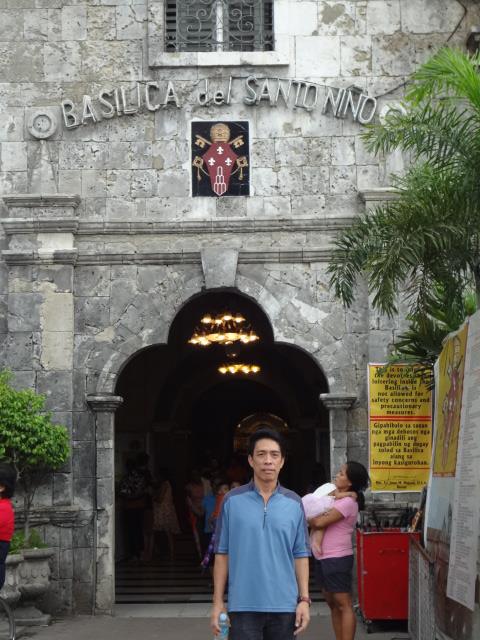
Basilica del Sto Nino: An Eco-Historical Spiritual Travel

The Historic Basílica Minore del Santo Niño de Cebú (Minor Basilica of the Holy Child of Cebú) commonly known as the Santo Niño Basilica, is a minor basilica in Cebu City in the Philippines that was founded in the 1565 by Fray Andres de Urdaneta O.S.A. and Fray Diego de Herrera, O.S.A.. The oldest Roman Catholic Church in the country, it is built on the spot where the image of the Santo Nino de Cebu was found during the expedition of Miguel Lopez de Legapsi.

It's an opportunity for me to reached this place and a blessings as well  when we are having  seminar retreat at Holy Family Retreat House in Lahug, Cebu City. I should be thankful to Br. Dondon who accompanied me in going to the church. The church was still undergoing renovation in year 2014.


The garden inside the compound was beautiful


HOW TO GET THERE

There are ways to get from Manila to Basilica del Santo Niño by plane, bus, car ferry or ferry

Mag-aso Falls Eco Travel: Negros Occidental

It's a blessings for me to reach the enchanting green Mag-Aso Falls in Kabankalan City. I should be thankful to Christian Brothers because during my stay with them they brought me here on their free day together with the sisters.
Amazing Mag-Aso falls is located in Barangay Oringao, in the city of Kabankalan, in Negros Occidental. The waterfalls’ name, Mag-Aso, originated from the hiligaynon word, aso’. Which actually means smoke. Are you wondering why smoke? It is because the twin falls, with the height of eight meters, create smoke after it falls.  It’s clear blue waters is one of the major reasons why a lot of people have started to love it.


Going down to mag-aso falls is dangerous and you have to watch your steps in going down.

After an hour of swimming at Mag-aso falls we're tired and  ready to go home


HOW TO GET THERE:


  • You can reach  Bacolod city either via private car, ferry, bus or plane.

  • Once you are in Bacolod city, get to the Bacolod South terminal headed to Kabankalan City. (This will be around 2-3 hours) Available buses are ceres buses

  • After you’ve arrived, get yourself a tricycle ride that could bring you to merkado Mercado is a small market where you can also opt to buy things you would like to have in the resort (food, towels, etc.)

  • From merkado, you can ride a jeep with a route to Mabinay and just inform the driver you are headed to Mag-Aso.

  • You can take a tricycle to the resort after.

Tuesday, October 7, 2014

Balicaocao Eco Park: A Day with Christian Brothers


Balicaocao Highland Resort, simply known as Balicaocao, is located in Brgy. Orong, Kabankalan City, Negros Occidental.  It's a blessings for me when I reached this place and I should be thankful to Edmund Rice Christian Brothers Philippines  of their efforts to bring me here during my stay with them and I  will humbly mentioned them as follows: Bro. Rod, Bro. John,  Bro. Luke and Bro. Dennis


Balicaocao is more than 500 feet above sea level giving you a panoramic view of the coastal towns of southern Negros. It is also a perfect place to watch the beautiful sunset of the island on top of a hill while relaxing or having a picnic with family or friends.
Once you get there an entrance fee of about PhP 25 per head is collected upon entrance. You can roam around and  just sit at one of the benches or if you have  a tent at the camp site or rent a small open cottage for day.
 For big occasions, there’s a pavilion that can accommodate 200 persons. Those who would like to stay for a night, there are also cottages that can lodge the whole family.


Pose only brothers the zipline is off

I want to go back to my childhood days ahaha.


They have swimming pool if you want to swim at an affordable price.

When we reached this place the zipline is not functioning maybe under maintenance

One thing that captures my eyes here is the beautiful small green rice terraces that adds beauty to panoramic view.

Bro. Joe's unforgettable pose in this green beautiful park

How can I resist to pose with this beautiful panoramic view of rice terraces

Sorry bro. John  zipline is not functionng..

What a stunning bridge connecting the two mountains here in Balicaocao eco park


How To Get There


We reached this place by private car  but for commuters from Bacolod City, take a Ceres Bus from the terminal at Lopez Jaena Street.  The bus leaves the terminal every 30-40 minutes.  


From Kabankalan, take a tricycle or single motorcycle to the resort.   A round-trip of the Tricycle may cost from P200.00 to P300.00.  Tricycle fare from Kabankalan to Balicaocao is P30.00 per person.  These tricycles make regular trips to the resort until about 5:00 p.m.  But, it would be good if you have your own car. 


You can also make arrangement with the City Tourism Office of Kabankalan.

Friday, September 12, 2014

HImamaylan Travel: A Home Visitation to NSDN Students:


Himamaylan Travel : A Home Visitation to NSDN Students


Visiting  student’s home and family is not an easy  activity. You have to reserve your guts, strenghts and  patience to cross rough roads, rivers, climb mountains and walk a long miles.  If  the house of your students are located in far away  province and mountainous area you will experienced all of these difficulties to reach them.

We are crossing the river during NSDN student's Home Visitation

 Home visitation is a type of school strategy program that NSDN adapt and used to provide evaluation and many different kinds of interventions to target participants students. Home visiting programs can vary widely in their goals, students, providers, activities, schedules and behavioral  structure. They share some common elements, however. Home visiting programs provide structured services. Nuestra Senora Delas Nieves School offers this type of program wherein every year  there is a schedule of home visitation. All  teachers have to visit  student’s home that needs to be follow up in terms of their status in academics, social, family and personal problems. 

Crossing the farm and climbing mountains to reach student's home

Purpose of Home Visitation


Home visiting programs are designed and implemented to support families in providing an environment that promotes the healthy growth and development of their student. Programs may target their services to families and caregivers who are at a particular disadvantage when it comes to establishing and maintaining such an environment. They may also focus on families in which the child is more vulnerable than the typical child because of health or developmental concerns.

Finally, home visiting programs are attempting to achieve some change on the part of participating families—in their understanding (beliefs about child-rearing, knowledge of child development), and/or actions (their manner of interacting with their child or structuring the environment)—or on the part of the child (change in rate of development, health status, etc.). Home visiting also may be used as a way to provide case management, make referrals to existing community services, or bring information to parents or caregivers to support their ability to provide a positive home environment for their children


Teachers Learned the  Reality of  Student’s Life


Aside from the most challenging things a teacher  has to experience  is the reward of  getting to know the real situation of student’s life and community.  This is the most important part because once  a teacher returns to classroom he or she  changed  the attitude in dealing with the students  inside the classroom. A teacher has now the basic knowledge of student’s  life  why he is always absent , why he is always  late  it’s just because his house is located in a far away mountains.

At last we reached the last places to visit.
 A  memorable experience

Although it’s really  difficult to travel to mountainous area and long distance  places just to reach the family of students at the end of the day it is  fulfilling on our part who took the travel with purpose and dedication. No matter  type of challenges that awaits us  what is important  we have fulfilled our goals for the day.

Families and neighbors we visited our so accommodating  and kind  during our visitation. What I liked best was the freshness of air  and fruits in the province.  If I were asked to come again for home visitation I will still join since I believe  students  are the hope of tomorrow.